Information |
Update November 7, 2025: All direct QSL requests received until now have been answered by mail this afternoon. Future direct QSL requests will be processed every two weeks. Note that I will participate in the 3Y0K DXpedition to Bouvet, and so I will be unable to process any requests between Jan 28 and Mar 11, 2026.
Cezar, VE3LYC
Update October 19, 2025: After several weeks on strike, Canada Post announced that they will return to work, but… will also continue the strike… on a rotational basis. I’m not sure how this will be conducted, for how long, and what delay will involve. The QSL cards for 3G1P and AT2AH have been printed in Italy by Alfio, IT9EJW, and I arranged for them to be shipped to me by courier service. I am currently working on preparing the QSO labels and the envelopes to reply to the direct QSL requests received once the cards arrive.
Note that I plan to mail all the direct requests in one batch by driving with them across the border and send them from the United States. I urge those who postponed requesting their cards via ClubLog’s OQRS to do it sooner rather than later. I will only take one trip to the States, most likely in early November. Any future mailing will be made through Canada Post.
73, Cezar, VE3LYC
Update October 12, 2025: QSL cards have been printed in Italy more than two weeks ago, but they have not been shipped to Cezar in Canada yet. This is because Canada Post have been on strike for the last few weeks, and so they will not be delivered. Cezar is waiting for the AT2AH QSL cards to be printed, and will organize both sets of QSL cards to be shipped from Italy via courier. Meanwhile, all QSOs of those who requested direct QSL cards have been uploaded to LoTW.
Update August 26, 2025: VERY BAD NEWS
Juan and his crew reached the rock before 9 am local time (before 15 UTC). The photos he shared with us didn't show any of our stuff up there. However, Alex - one of his crew - climbed the rock. There is absolutely nothing there except for the beam antenna that we left anchored, which has been damaged. We left it there because it was too slippery at the time to attempt disassembling it. There is no trace of the sealed drum and one of the generators, which was left in its hypalone bag. We are truly disappointed. We could not have taken with us during the extraction the KPA500 or the generator, since they were too heavy, but we could have taken more stuff had the rescue team didn't mislead us that they will bring these things down the after we reach to the boat.
The lost equipment includes the KPA500, one IC-7000, seven Dunestar-300 band pass filters, two multiband antennas, one 2-el yagi, one Honda EU22i generator, two fiberglass masts, all Cezar's personal clothing and sneakers, etc. The estimated replacement value is well in excess of $8,000. To be clear, this loss is the responsibility of our team. However, we would very much appreciate all the support that the IOTA and DXing community can afford to offer. Thank you!
Update August 25, 2025: Cezar postponed his flight back by two more days, as the sea forecast looks good tomorrow and the day after. Unfortunately, this comes with a significant airline penalty, exchange fee, and difference in the cost of the ticket. There are also additional costs associated with the extension of the stay in Iquique, travel to and from Caleta Lobos, and obviously the service provided by the fishermen. We have the necessary funds to cover all this, but would appreciate if those who can afford to include a small donation with their OQRS submission will be willing to do it.
Update August 24, 2025: Sea conditions didn't allow the recovery of our equipment and clothing yesterday or this morning. Felipe left Iquique just a little while ago and is now on his way back home. However, I will continue to stay here until the recovery is finalized. The log will be uploaded to ClubLog later today, but it will not be open for OQRS until confirmation is received from the IOTA Management that the operation was validated toward credits.
Update August 22, 2025: The fishermen assessed the sea conditions this morning and decided against attempting to retrieve our components today. As such, we packed the rest of the components, which didn't make it to the island, and moved back to Iquique. Felipe is now shipping some of the stuff back home. His flight back to Puerto Vargas is on Sunday morning, Aug 24, while mine is in the afternoon of Monday, Aug 25. The fishermen will attempt to retrieve the rest of our equipment every day until they are successful, and keep us informed of the results. Interestingly, today around 9 am local time it rained. Then, around 11 am it rained against for bit. Not a lot, just enough to make us realize how lucky we were to not have had to deal with
this on the island.
Next, we need to formally have this operation validated toward IOTA credit, after which we will uploaded the log to ClubLog and open the OQRS. Please be patient.
Update August 21, 2025 at 19:00 UTC: QRT!
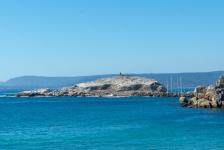
Landing on the large Pajaros rock in the morning of Aug 18 went as planned, but we were unable to find any possibility to install our tent on the top of it. Consequently, we decided to operate under the open sky. This was fine during the day, but difficult at night, particularly since a chilly wind started to pick up around midnight local time, making it difficult to withstand the cold of the night. However, we had inflatable mats and sleeping bags which we were able to use. The highly unleveled top surface became extremely slippery after dark, as air humidity condensed on the old guano rock, limiting our movement severely. We began operating on 20 m CW in late afternoon, and continued to do so until about 7 UTC, when we were very tired and decided to rest for the night.
The second day we continued operating on 20 m CW at first, after which we moved to 15 m SSB. As the day progressed, the ocean swell became visibly higher, reaching just under the top of the smaller of the two Pajaros rocks, while the associated spray would cover it in its entirety.
The little rock has a height of 12 m, while the larger rock, on which we landed, 20 m. while we were located 3-4 m below it's top. As the day progressed, the generator - which we placed on a relatively flat surface a couple of meters below where we were seating - received a lot of water spray, which forced us to consider shutting it down and moving it up, despite that there was no flat surface available for it there. As such, we had no other choice then stop our our activity temporarily.
Late in the day we managed to build a nice place for the generator, which was successfully started, allowing us to continue our activity. We operated all night in 20 m SSB, and didn't restrict the takers until we noticed that far two many of them called us despite having made previous contacts on other bands/modes. Thus, we decided to announce that we will only pick up new stations, which didn't contact us earlier, aiming to maximize the number of unique stations logged. The operation continued using only one station, as long as the propagation lasted. We tried to periodically check its opening, but the pileup subsided substantially.
During the evening of the previous day, we were informed by the Coast Guard that the sea condition will worsen to the point that on Aug 22 and/or 23 will reach a level of 4.1 on the 5 level scale. Consequently, they were preoccupied of our safety and indicated that they will re-assess the situation next morning. Thus, in early morning of Aug 21, Coast Guard announced us that they will come soon to pick us up. We immediately shut off our transmission and began preparing for evacuation. Before long we changed in wetsuits and later descended, under their guidance, the steep and slippery slopes of the big rock, following which we paced ourselves against the waves and swam through the high waves toward their boat. Most of the materials that we brought with us remained on the rock, nicely packed. They will hopefully be brought down at some point, but only future will tell.
We reached Caleta Lobos at about 17:30 UTC, after which we dried ourselves out, washed a bit, dressed in dry clothes, and breathed happily after a pretty daring extraction. This project was without a question a very difficult one, which included a number of risks that we were able to manage, a true adventure in every sense of this word. Its full story, with its details, and all the incredible twists and turns, will be certainly written and published later on. For the time being we are delighted to have been able to do it, and are sincerely grateful to all those who assisted us in the landing and extraction, as well as those who helped us along the way.
Update August 19, 2025 at 13:30 UTC: Second station is now up and running. Despite a strong wind for about 6 hours, the ops have been operating “open sky” – in other words no shelter has been built yet. [TNX DX-World]
Update August 19, 2025: They have been on 14.040 CW for some hours this UTC morning.
Update August 18, 2025: We are on top of the large Pajaros rock. There is not a lot of space and very uneven. All the equipment, gen, etc. everything is on the island, at the base of the rock. We are bringing everything up and then we'll see what and how we can install things. I don't think that there is space for setting everything up, but we'll see.
This has been so far my most difficult landing, far more challenging than Bouvet 2023, and more difficult and risky than Escondida. But we are here.😊
73, Cezar
Update August 17, 2025: The operating team along with the logistical crew drove to the rock this morning bright and early. Unfortunately, the sea didn't cooperate, as the hull and the currents were outside of what the leader of the logistical group considered acceptable landing conditions. Moreover, the weather forecast is not looking good for the next 3-4 days. Meanwhile we decided to inspect a couple of other little rocks, which seemed at first to potentially qualify for this IOTA group. However, upon further checking, we concluded that they do not meet the conditions. We are back in the village and are evaluating our options.
Update August 16, 2025: With all shopping done, wetsuits rented, we are now waiting for the truck to come to our accommodation in Iquique to take us to Caleta de Lobos. We'll need some time to load everything properly in the truck's bin, but we aim to be at our destination by 19 UTC or shortly after. The plan is to attempt landing tomorrow morning, and be operational by early to mid-afternoon local time.
Update July 25, 2025: During our repeated discussions with the leader of the logistical team, a respected fisherman from Caleta Lobos, he indicated that his major concern for everyone's safety is the presence of the guano on the rocks. Under the ocean spray, the guano on the inclined rocks will be wet and extremely slippery. Consequently, he planned to install a couple of ropes on the
island, meant to provide us with support while climbing to the intended campsite, on top. We also decided to incorporate an additional contingency by having Felipe build a 7 m long rope ladder, which we will be able to installed, if needed, with 10 mm diameter rebars hammered into the vertical limestone rockwall.
The leader of the logistical team visited the island twice during the last few days. His first visit was on July 20, late morning, when the sea was pretty rough. He managed to put foot on the island with great difficulty, after which he scouted the place for the best path to the top, and installed a couple of ropes in the process, which he secured and left in place. He returned to the island on Jul 23, early morning, when the sea was very calm and allowed him to bring some rock anchors for our tents and masts. It was his decision to go for rocks rather than plastic kegs filled with sea water.
Team members had a zoom meeting on July 24 in which they went in great detail over the radio equipment. Given the highly variable sea conditions, they decided that the radio, generators, camping gear, food, water and fuel supplies will be packed such as to be deployed in two phases. If sea conditions are good, both phases will be implemented right away, one after the other. However, if sea conditions worsen, or are difficult to begin with, only the first phase will be deployed, while the second will be attempted a day or two later.
Furthermore, in order to better take into account the variability of the sea conditions, the team plans to work very hard in Iquique in order to finalize the rental and purchasing of various components necessary for this project faster than originally scheduled. If successful, they intend to arrive in Caleta Lobos one day earlier, on Aug 16. There, they will do their best to have everything prepared for transportation to the island. If the weather and sea conditions cooperate, the team will attempt landing one day earlier, on Aug 17. However, if the sea conditions are difficult, they may have to wait, as the decision to go remains with the leader of the logistical team.
Update July 9, 2025: In five weeks, our team will head to Iquique. The generators, sealed drums, various radio and other components will be shipped there in advance, and stored in a warehouse. Other radio components, laptops, and accessories will arrive with the operators, as accompanying luggage.
Here is the day-by-day time schedule:
- Aug 13: team members will depart from home and travel to Iquique.
- Aug 14: meet in Iquique (mid-afternoon), and arrange transportation to Caleta Lobos.
- Aug 15: shopping for camping gear, including tents, tables, chairs, mats, and sleeping bags.
- Aug 16: shop for water, food, and fuel supplies, as well as miscellaneous components.
- Aug 17: rent wetsuits, load a truck and a van, travel to and overnight in Caleta Lobos.
- Aug 18: wake up very early, load two fishing boats, arrive at Pajaros around 6 am local time. Land all people and components, move everything on top of the island, and setup camp. Get on the air by mid-afternoon local time.
- Aug 19-22: on the air from Pajaros.
- Aug 23: shut down before sunrise and prepare to leave the island in the morning. Leave all camping gear and miscellaneous components with the fishermen of Caleta Lobos. Drive to Iquique and return the wetsuits.
- Aug 24: Sell the generators. Prepare personal bags for the return trip home.
- Aug 25: Depart from Iquique. Felipe arrives back home the same day.
- Aug 26: Cezar and Johan return home.
Note that we won't be able to install anchor pegs on Pajaros for either the tents or the antenna masts. This is because the top of the island is covered in a very soft and more than 50 cm think guano layer. Furthermore, there are no rocks on the island that we can use for anchoring purposes.
There are only huge boulders there, similar to what we encountered on Escondida (LU6W, SA-096) in 2015. Consequently, our plan is to bring rocks from Caleta Lobos. For two tents and three masts we'll need at least 21 anchoring points, or close to... 200 kg of rocks! Worth mentioning, all the rocks that we'll bring on Pajaros will have to be brought back to the village!
We are immensely grateful to the groups and individuals who extended to us grants and donations. Their unreserved trust and enthusiastic support energized and determined us to incorporate even more contingencies in the logistical plan of this challenging project. Meanwhile, we continue to look for donations from those willing and able to help us defray more
of our costs.
Update June 15, 2025: The team continues to work on various continencies meant to ensure that all people (three operators and one helper) and materials will be successfully landed on the rock from the first attempt. As such, in order to take advantage of the most favorable sea conditions in early morning, we agreed with Juan, the head of our logistical team, to organize everything in only one transport from Caleta Lobos to Pajaros. This will require two boats instead of one, but it also offers the advantage that drivers will be able to support each other during the landing operation.
Only Juan though will remain in stand-by, day and night, during our entire activity from the island. We are also re-evaluating the type of sealed drums we need to purchase, in view of the cost and available supplies, and look into having them tested.
Update May 31, 2025: Following discussions with the Chilean Coast Guard, the team developed a Safety Plan, which included an identification of hazards, as well as the mitigation of various risks associated with them. The plan also specified the name of the person who will lead the logistical team from Caleta de Lobos. The document, prepared by Felipe with feedback from the rest of the team members, was transmitted to the Coast Guard on May 23, and we are happy to report that we received their approval today.
Meanwhile, we are working on the logistical plan, and as part of it we purchased custom-made hypalon bags for the generators. These are somewhat similar to drybags, but much sturdier and heavier, made from rubberized polyurethane. These are the same type of components we have used for the Bouvet DXpedition in 2023 and will be using again in 2026.
Cezar VE3LYC, Felipe XQ7IR, and Johan PA3EXX will attempt to operate as 3G1P from Ilotes Pajaros (SA-100 New), the only counter of this IOTA reference, on August 18-23, 2025..
This is a daring project, involving a number of hazards and risks, and the team hopes that island chasers and DXers at large will support their effort. Depending on the available space, the team intends to install and operate two or three stations, as much as possible around the clock, using CW, SSB, and FT8 on 10 to 40m.
More information and a call-for-support are available on the DXpedition website.
|
 DX news and calendar: 3G1P




 Home page
 Site map
 Radio Sherlock search engine
 Terms of service
 Privacy
 Cookies