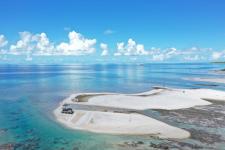
Update April 13, 2023: FO/AA7JV is now QRT. On April 10, 2023, NCDXF Directors successfully concluded their 11 day ground-breaking experiment from Tikehau Atoll in the Tuamutu Islands, French Polynesia, with a remotely operated DXpedition. While FO is not rare for DXCC, Tikehau, OC-066, was needed by 72% of the active IOTA chasers.
AA7JV, George and KN4EEI, Mike, arrived at Tikehau on the morning of March 28 and deployed 2 RIBs (see below) in a matter of hours. In addition to their CW and SSB QSOs done locally (from the ship), a total of over 11,000 FT8 QSOs were made completed remotely. The remote operators were N1DG, AA7A, K6MM, K6GFJ and ND2T. The station was accessible 24/7 using home computers and desktop sharing software. No specialized hardware or software was required. The operators were working from their homes in shifts, just like on a regular DXpedition, without the cost and hassle of traveling.
This operation did not use any unattended operation (as required by ARRL DXCC rules). All callsigns were selected by the operators for a QSO.
This RIB Landing craft brought and returned all equipment needed on the Atoll in one trip. All radios, generators and fuel remained on the lander.
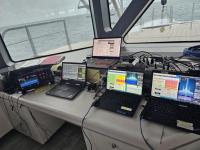
The remotely operated stations were connected to the Internet via a Starlink satellite connection. Operating mode was FT8 and FT8 F/H. The radios were Flex 6700 radios housed in the NCDXF sponsored RIB stations that were put ashore by the AA7JV/KN4EEI. Operating power was 100 W and each station had its own vertical antenna. AC power was provided by Honda EU2100 generators running in the ECO mode. The stations were on the island unattended, with remote supervision and control from the catamaran Magnet, which was anchored a mile off-shore.
The NCDXF RIB (Radio In a Box) is a complete, fully wired station in a weather-tight box. The RIB integrated a Flex 6700 SDR radio, an amplifier, power supplies and a comprehensive Raspberry Pi based control system developed by KD4Z. The RIBs were designed to eliminate the need for camping and to make DXpedition set-up faster (hours, instead of days). For more information on the RIBs see the NCDXF Winter newsletter at ncdxf.org. In this Remote DXpedition experiment a dual-radio version of the RIB was used, which contains two complete 100 W stations in a single box.
A RIB will be shown at the NCDXF booth at the International DX Convention in Visalia, Apr 22, 2023 and plans are also being made to allow convention goers to operate the RIB Friday evening.
In development and testing since early 2022, the NCDXF Remote RIB technology is aimed at future DXpeditions. It is intended to enable remote operators to participate in DXpeditions without the expense and lengthy travel usually involved. Kevin Rowett, K6TD, President of NCDXF commented "Remote DX operation will bring the opportunity to participate in DXpeditions and share the excitement of handling the pile-ups to a wide range of radio amateurs. It will also allow future DXpeditions to have a smaller number of on-site operatross, reducing the expenses and footprint of future DXpeditions." Ken, WZ0L wrote us: “Now that's the way to activate an island.”
The NCDXF mission is to make DX happen. The NCDXF has been aware for some time that financing is not the only obstacles faced by would be DXpeditioners. The NCDXF has sponsored the development of the RIB technology to lower the threshold of obtaining landing permits to ecologically sensitive areas. Later in 2023 the Magnet hopes to visit other DX locations, including an entity or two in the top 20 most wanted. We trust this just concluded operation is one of the final steps in demonstrating to the permitting services that limited intrusion to the island is possible and Amateur Radio can be made eco friendly.
73 de AA7JV, KN4EEI, and the remote team.
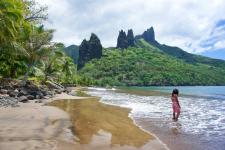
Update March 24, 2023: FO/AA7JV went QRT from the Marquesas Islands on 20 March at 16.10 UTC. Mike, KN4EEI and George operated from Anaho Bay, on the north side of Nuku Hiva. They put on the beach two RIB (Radio In a Box) stations and two antennas; due to software issues they worked CW and SSB, and only made a handful of FT8 QSOs. "Low band conditions were poor, made worse by the difficult geography of the bay", George says, but "we seemed to have very good signals on 30 and 10 metres, and good on 40 and 20". This was the first operation where the RIBs were used in an actual DXpedition.
The "Magnet" is now going to the Tuamotu Archipelago (OC-066), French Polynesia, where Mike and George expect to be QRV again as FO/AA7JV starting around 27 March until around 5 April.
QSL via HA7RY and LoTW.
DX-World informs that KH7Z and AA7JV are QRV /MM head ing to the Galapagos Islands and that then plan to head to the Marquesas islands, arriving around March 18 and, staying there until March 30. They will put ashore a small DXpedition with three stations: 2 x 100W FT8-only remotely operated stations and a full power locally operated CW/SSB station that will be on the air from 160-10 meters. The remotely operated stations will be on 80 to 6 meters.
After this activity from Marquesas, they will operate from the Tuamotu islands as FO/AA7JV, probably until April 5.
Once departing FO-land they intend to sail to E5 (Cook islands) and then onto American Samoa
|
 DX news and calendar: FO/AA7JV




 Home page
 Site map
 Radio Sherlock search engine
 Terms of service
 Privacy
 Cookies