Information |
Update November 8, 2022: "Our DXpedition P29RO ends in a few hours. On local Wednesday morning, November 9th, we will start dismantling the antennas. QRT is expected at around 0400z. We are happy to have reached the 90,000 QSO mark from 160m to 6m on all main modes with some stations still calling for the first QSO towards the end. 160m has been extremely difficult due to the local QRM situation. Nevertheless, we are happy to have roughly 550 QSOs on Top Band in the log.
This expedition involved a lot of logistics and didn’t come cheap. The climate took a heavy toll and sleep was also neglected. At the end of the day, we are very happy with the result. We appreciate the many positive comments that reached us. Our flights to Germany will leave on Thursday and we should arrive home after some 30 hours on Friday.
Please wait for the final online log. Our QSL manager will do his best to correct errors beforehand. We hope to receive our nice color QSL in four weeks to start sending out QSLs and the LoTW upload for donors before Christmas. On behalf of the entire team, I would like to thank everyone who supported us with a donation." [DL7VEE]
Update November 2, 2022: "After a week and almost halfway through our stay, it’s time to sum up.
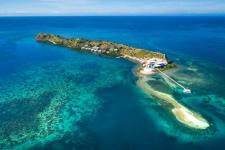
The choice and decision for this location was a very good one. Just off the coast of Port Moresby, the capital of Papua New Guinea, the island of Loloata is situated. It can be reached in a few minutes by ferry from the mainland. The luxurious Loloata Private Resort is a modern holiday complex for day-trippers and tourists. Electricity is available 24 hours a day and good internet is provided. The warm and humid climate is a challenge for central Europeans. Working in this heat takes a lot of energy!
We were able to install our antennas on the hiking trail on the mountain ridge. With water around the island and a free takeoff into almost all directions with no disturbances from the hotel complexes down on the shore, this is one of the best possible QTHs for worldwide radio operation. However, this comes with a downside: we needed roughly 60 m of coaxial cable for each antenna. On the high bands, we only use a robust two-element wire beam from LZ Antennas. A pentaplexer from LBS allows us to operate simultaneously three bands from 20 to 10 m, each with 500 watts HF. Loops are used for 30 and 6 m. For the other bands 160, 80, 60 and 40 m, we use verticals with an elevated radial.
We are very happy with the propagation and the good RX situation from 40 m upwards. After 7 days we already have over 55,000 QSOs in the log. The pile-ups are still tremendous. We have strived for equal operations on all modes and bands. The FT8 stations are also manned. All operators work in rolling shifts. 4.5 hours at the station and 9 hours free for eating, sleeping, checking emails and making repairs.
We have major hearing problems on 160, 80 and 60 m. On these bands, the noise level is always at S9 plus! Possibly an atmospheric problem near the equator at sunspot maximum and not man-made noise. That means stations calling us have to be louder than the noise floor. 80m CW is very hard to read. Under these circumstances, all OPs agreed that CW operation makes no sense on 160m.
A note on FT8 Fox & Hound. We use WSJT-X, not MHSV. This means, the confirmation must be on our transmission frequency. Additionally, those who call us below 1,000 Hz can’t be worked. There are still a lot of stations from all parts of the world who cannot work correct F&H. So fare in last days we may use normal FT8 mode.
Due to the hot climate, we have to finish the antenna dismantling a day earlier. We are therefore only QRV until November 9th around 4 UTC."
Update October 26, 2022: They became QRV yestedary, putting good signals in Europe.
Update September 8, 2022: Suggested frequencies:
CW - 1822.5, 3528, 5354, 7002, 10102, 14028, 18086, 21028, 24906 and 28028 kHz
SSB - 3805, 7092, 14210, 18120, 21275, 24955 and 28465 kHz
RTTY - 7044, 10145, 14095, 18105 and 21095 kHz
FT8(F/H) - 1836, 3567, 5356, 7056, 10131, 14090, 18095, 21090,24911 and 28090
6m - 50105/CW, 50125/SSB and 50323 kHz
Update September 6, 2022: Operators will be DL7VEE, DG2RON, DJ7TO, DJ9KH, DJ9RR, DK3CG, DL1KWK, DL2RNS, DL4SVA, DL6KAC and DL7JOM.
They plan to be QRV 24/7 on 160-6 metres CW, SSB, RTTY and FT8 (F/H) with four well equipped stations.
A group of German operators with be active on HF bands as P29RO from Loloata Island, OC-240, Papua New Guinea from October 25 to November 10, 2022.
QSL via ClubLog OQRS and LoTW.
|
 DX news and calendar: P29RO




 Home page
 Site map
 Radio Sherlock search engine
 Terms of service
 Privacy
 Cookies